Tall Socks – Mark Cohen
Over the years, I have frequently heard the opinion that Mark Cohen’s work is for the initiated, his unconventional framing being an acquired taste more likely agreeable to those familiar with the history and conventions of street photography. While prior knowledge of any subject certainly deepens one’s appreciation, it can also lead to a perfectionist attitude that overemphasizes technique and undermines the genre’s defining characteristic: its capacity to arrest life on the go. Only the best can strike a balance between technique, authenticity, and that indescribable ability of being attuned to the rhythm of the moment. While Cohen is not as well-known as Bresson, Frank, Winogrand, Friedlander, or Erwitt, he belongs to a select group of practitioners able to balance those very criteria mentioned above. Cohen has expanded the genre’s visual language through the closeness to his subjects, eccentric angles, and use of a ghostly flash.
Only the best can strike a balance between technique, authenticity, and that indescribable ability of being attuned to the rhythm of the moment.
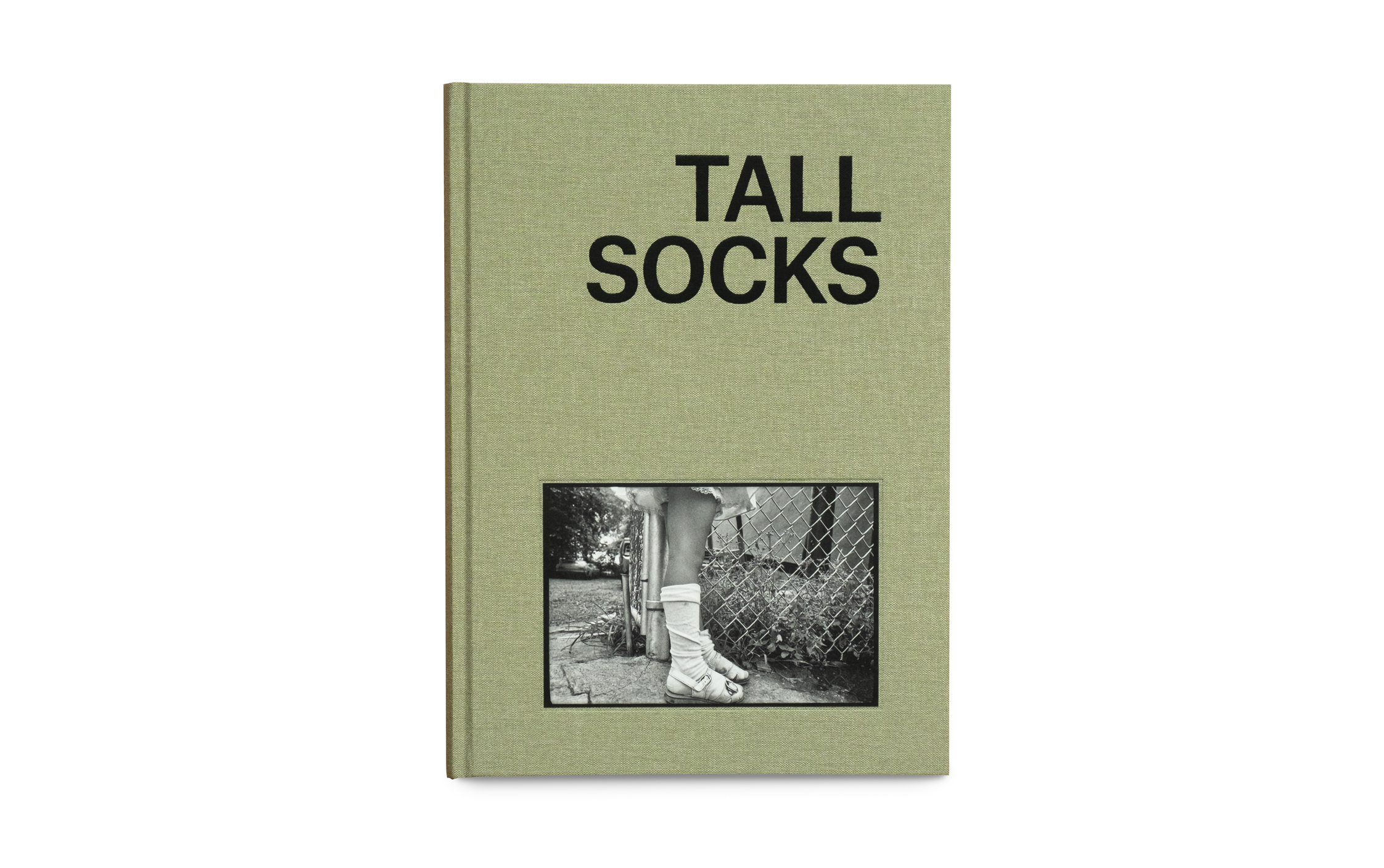
The issue of technical competence also relates to the photobook as a medium, which truly shines when it becomes more than a collection of fantastic single images. Cohen’s latest publication, Tall Socks, showcases his trademark vision, though the pictures also serve as a historical document of a time when a broader range of public interactions were tolerated. The book functions as a window into a picture-making period that some contemporary viewers now see as intrusive or even unethical (the eternal question with this kind of work). The photographs were made in New York when Cohen, then a resident of Wilkes-Barre, Pennsylvania, attended a film workshop in the summer of 1973 (notably, he had already shown at the George Eastman Museum and MoMA). Photographs often grow in allure with time, one of the medium’s greatest assets and one Cohen has used to his advantage in recent publications. There’s pleasure in noting the markers of another era, and even more in spotting those things that, for better or worse, haven’t changed.


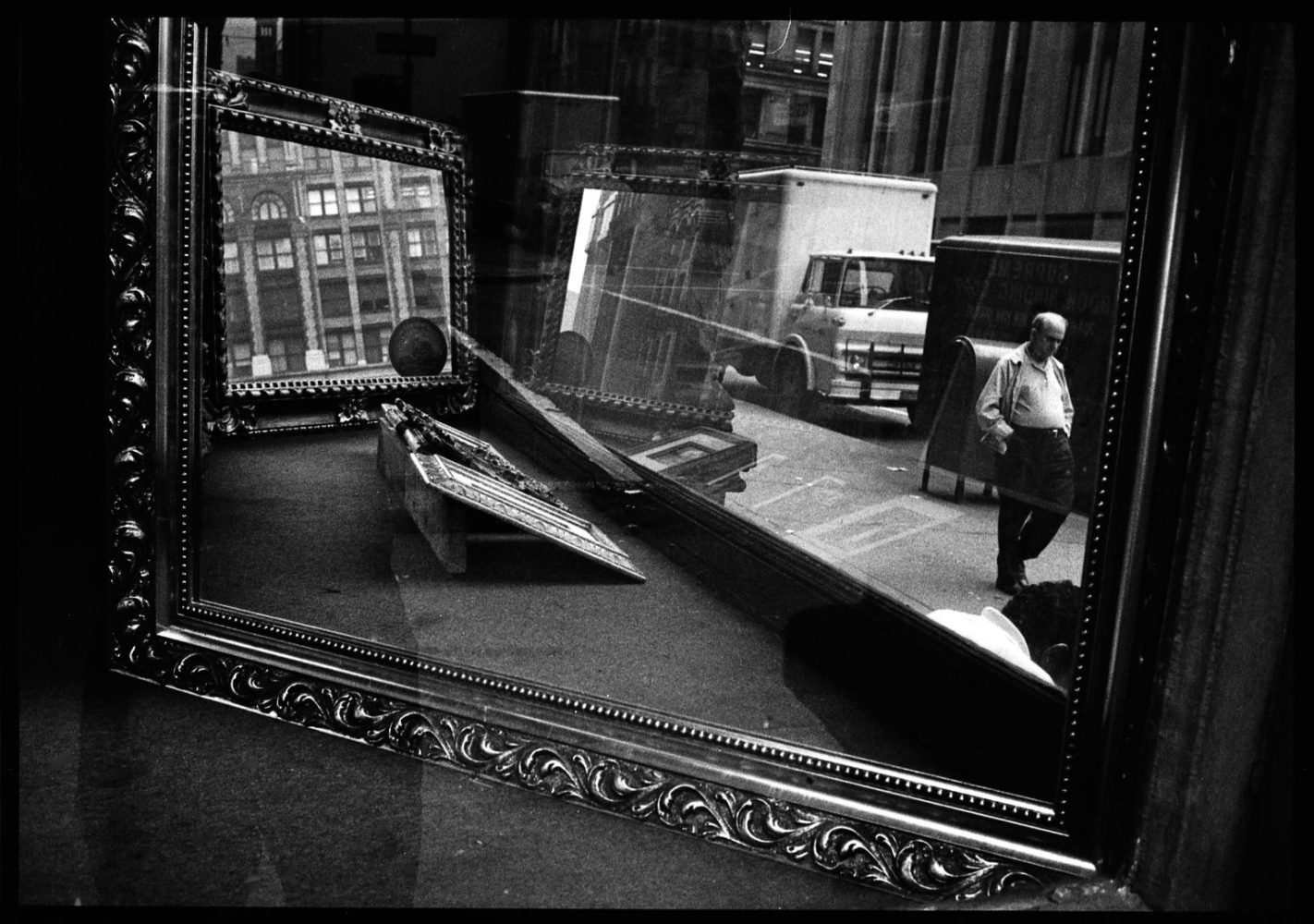
Cohen was clearly productive during his month-long stay in New York City more than fifty years ago. The publication moves swiftly between wider scenes, revealing close-ups of faces and even a few objects whose distinct charm is easily graspable thanks to the distance of time. Surprisingly, the book’s most intricate composition is a shop window in which the reflections of ornately framed mirrors suggest the multiple possibilities of a moment before it is arrested as a photograph. However, this composition differs from Cohen’s usual framing, which isolates body parts or cuts off the main subjects in unexpected ways, as in the picture of two women on a pay phone, where the frame’s tightness gives the scene a cinematic air. Some viewers might even get a sense of movement, as if this was a dolly shot closing in on the person making the call. Unlike the vast array of witty street photographers out there, Cohen avoids constructing meaning via the superimposition of elements that insinuate symbolic readings, preferring instead a kind of forensic directness (especially when the subjects are hit by his flash). This is not to say that Cohen’s pictures don’t elicit complex interpretations, but that they achieve their complexity through different means.
Cohen avoids constructing meaning through the superimposition of elements that insinuate symbolic readings, preferring a kind of forensic directness so that his pictures achieve their complexity through different means.
For instance, the picture of a mustached man in a Mickey Mouse T-shirt invites us to consider his fashion and grooming choices. How consequential are these in how we perceive him? Do we see his style as playful, immature, or the result of a lazy Sunday? Whatever the answer, the picture doesn’t aspire to be a Bressonian moment or a Warholian commentary on American Pop Culture, working rather like a quick psychological evaluation, similar to doing a double take on the street. While we don’t have to commit to a single reading, I believe his focus on psychology is an imperative that drives his practice, since similarly charged scenes recur throughout the book. In a picture that could pass for a photogram of a Cassavetes film, three older women pose uncomfortably for the camera. While the picture can’t communicate the women’s thoughts, we get to have fun conjecturing about their lives. What has often been said about Fellini also applies to Cohen. His work is a catalogue of fascinating faces and gestures that serves as a portal to a bygone era.

Cohen’s work – beguiling as it is unsettling – belongs to the highest echelon of street photography because it resists the lazy critique of the genre that affirms that these images are only exercises of style. But street photography is not merely about reacting quickly to create clever compositions. It is also a personal philosophy of perception and openness to what the world offers. Tall Socks offers something for different viewers. Purists will be relieved to learn that the black edges of the frames, which signal that nothing has been cropped out, have been dutifully preserved. Others might enjoy how the layout deviates just enough from the genre’s conventions, adding dynamism to the sequence. Book lovers will enjoy its spectacular tonality, which makes the images gain in depth. People who think they know precisely how things are and always will be won’t bother to take a picture like the one on the book’s cover, finding such a scene blindingly obvious. In this sense, imagining how Cohen captured some of these moments can be a revealing mental exercise that extends the range of experiences suggested by a seemingly ‘traditional’ photographic genre.
Mark Cohen
GOST 2025