

Michael Lundgren – Glass Mountain
In Glass Mountain, Michael Lundgren extends his longstanding engagement with the geological and the unseen into a body of work that treats landscape not as stable ground but as a site of emergence. The publisher’s framing of the book as an ‘uneasy meditation’ on transformation is borne out in a practice that, as he describes in our conversation, unfolds through accretion rather than idea: images made over more than a decade coalesce into a field of movement, ambiguity, and suspended time. Stones appear to quicken, scale falters, intentionality becomes uncertain, photographic narrative dissolves into ritual. What emerges is not simply a reconsideration of nature, but a sustained inquiry into perception itself – into those moments when recognition breaks down and the world, briefly, becomes animate again. Michael and I spoke at length – the transcript below is a condensed version of our rambling discussion.
Eugenie Shinkle: Where did this work begin?
Michael Lundgren: The work started largely with photographs of stone. The earliest images in it date back to COVID. There was a grid of six that hung on my studio wall for a year, and the stone felt like it was alive, like something glowing or activated from within. There’s a quality of genesis in these pictures – rather than the discovery of something that was once alive, it’s almost as if it’s coming into being. There’s a sense of movement within stone that I’m after. And I think that the whole book has this sense of movement to it; of ongoing change and evolution and transformation in the landscape.
I think that the whole book has this sense of movement to it; of ongoing change and evolution and transformation in the landscape.
ES: We tend not to think about photography’s time signature when we’re photographing landscape, but the idea of the ‘instant’ is often disconnected from the timeline of what’s around us, particularly rock. I spent a lot of time thinking about this this summer – about my own timeline in comparison to the timeline of the rock formations that I’m photographing.
ML: I think there’s a parallel between what I do and what you do – something about the way that you’re reimagining spaces through multiple images that strikes a chord with me. There’s a tendency in the photography world to find one way to see something and then to repeat that, but you’re trying to see something from many different angles by using this multiplicity of images. I can relate to that because I’m trying to see something from as many different positions as possible, and that’s where the movement in the work comes from.
ES: There are so many images in Glass Mountain where you’ve captured this sense of movement – this one, for instance, where a snake appears to be oozing out of a wave of aggregate.

ML: I actually made that one about a decade ago; it was an outtake from my second book, Matter (2016). That happens with every body of work: there’s no place for certain images in the work that’s being made, but they’re still compelling and strong and they get put into a box somewhere and then ten years later I’m ready for them. I think that’s a key image: the snake entering the earth to shed its skin and be reborn – and it’s probably the closest thing to living wildlife in the work. But it sat in the back of my mind for all these years, and then, halfway through the making of this book, it found its way in.
I’m not really interested in making a body of work that’s separate or disconnected from what I’ve done before. I see them all as connected and evolving.
I’m not really interested in making a body of work that’s separate or disconnected from what I’ve done before. I see them all as connected and evolving. I’m an intuitive photographer. I go out into the world, make photographs, bring them back and let those photographs change how I see the world and go back out and make more. There’s no predetermined idea, no predetermined concept or subject matter. The meaning of the work comes from the way it builds. It’s an accretion of images.
ES: It’s really interesting that you would use the word accretion because it’s a geological process, isn’t it? It’s the process of accretion that creates rocks that then get heaved up and sedimented and dragged back down to the earth’s mantle. There is a real sense of that process taking place in this image.


ML: What I’m after is a sense of … I don’t know how to describe it, but it’s a condition of when you are in the unknown: you’re not convinced about what you’re looking at. It’s an experience that I have all the time, but you can’t create it. It happened to me yesterday – I was out in the forest and there was this black shape poking up out of the leaves and I was thinking ‘What is that? Is it a kind of rock that doesn’t exist here?’ I went over and I touched it with my foot – It was a piece of tar paper that had been rolled and folded over in a way that looked like a hunk of black basalt. That state is what I’m after in the pictures. We live in a world where we know what things are because we agree about what they are. Something happens when you fall out of that agreement.
ES: Language and meaning work the same way. We agree that we know what things mean, but really we can’t assume that meaning is shared. There’s no guarantee that when I say ‘cat’ or ‘rock’ you’re going to have the same kind of experience as I am.
ML: I understand what you’re saying very well. Although there are these agreements that put the world together and keep it running, in the end, they’re all different. We all see colour differently, we all understand and value and do things differently. On a personal level, it’s these moments where I walk through the world thinking I know what it is, and then suddenly it breaks down, that I become very present. There’s a shamanic tradition in the Toltec culture in Latin America where they speak of the doing of the world – when you’re doing the world, everything is as you expect it to be. But if you enter into a state – like me seeing that rock – of being outside belief, this shifts you out of your perennial mode of doing, it wakes you out of sleep in a way and brings you into a more animate state. That’s what I hope to achieve photographically. So in the rock formation you’re looking at in that picture, and you’re not totally convinced of what it is – is it under water? Is it the leaves of some kind of strange plant? – there’s this potential for movement. I’ve always wanted there to be more than one experience in an image.
ES: I associate a lot of your images with sound and the snake photograph, for me, is a kind of deep rumbling, like the sound of molten lava.
ML: I love that – I haven’t really thought about sound, but it’s true.

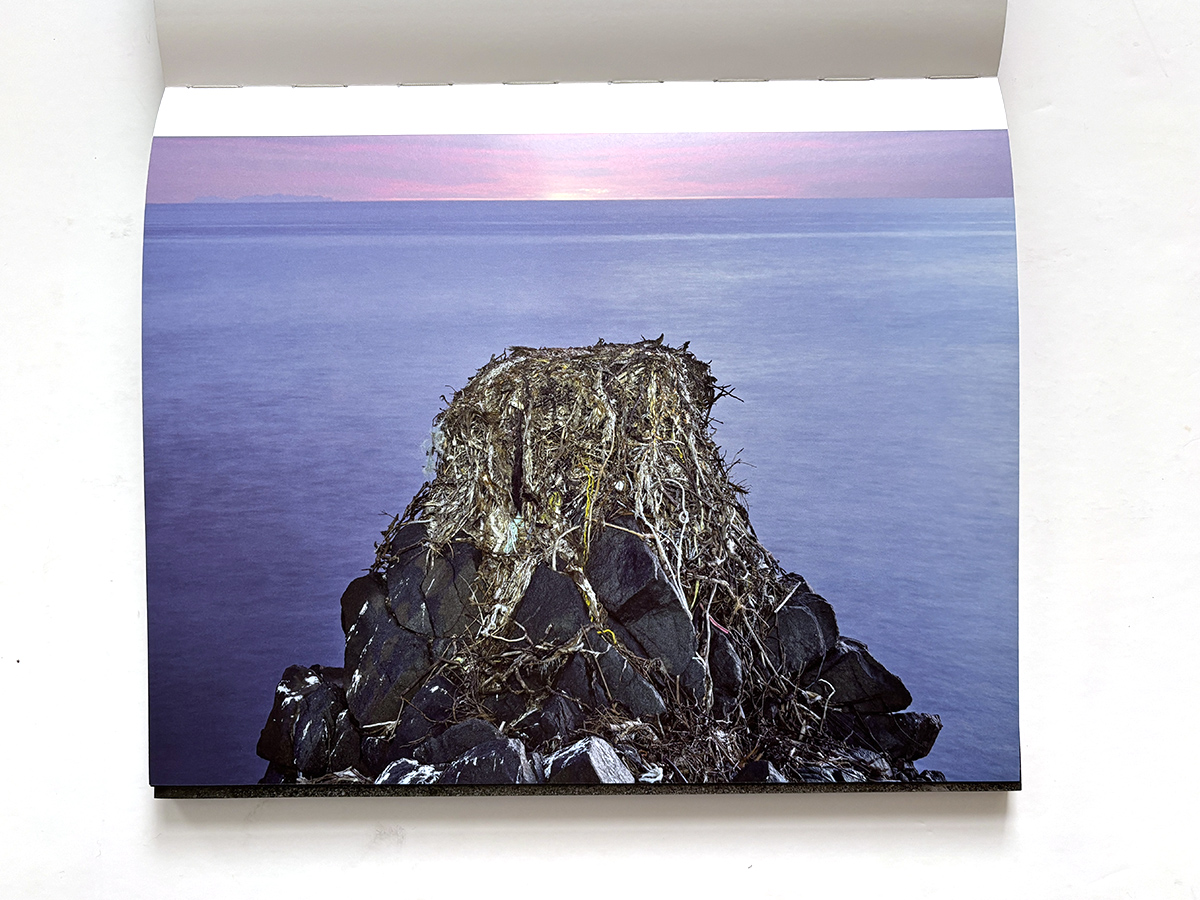


ES: Can you describe what draws you to particular places? Do you go back to the same places again and again?
ML: Not entirely. I do go back to the same places at times. I used to think when I was younger that I could make a photograph anywhere. I could go to a place and photograph there and then go again three months later and make something different. I used to live in the desert in Arizona and I loved going back to the same places because there’s an intimacy that develops between you and the place. Now I feel like I need to move. I’m drawn to places that have a multiplicity of forms in relationship with each other – where things exist that don’t seem like the things that are around them. And I guess I’m drawn to making photographs that have more than one interpretation, that have more than one entity within the photograph – where there’s a quality of duality.
ES: There’s also a quality of intentionality in a lot of the things you photograph. I’m looking right now at an object which I’m assuming is geological. But if you told me that it’s actually the result of a random concrete pour, I would also find that plausible. It’s not clear how it came into being, or what kind of intentionality is at work here.
ML: Yeah. I feel that in some way they’re photographs of something else’s intentionality. It was probably made by someone, but the pictures don’t give you that information. The play with scale is part of the secret too. The way the light works, the way that there’s almost a diorama quality to them. I’ve always been interested in the act of making a photograph as a ritual. It’s not just pointing the camera at the world, it’s an interaction, a performance, a collaboration between me and the world or me and something else. I love this idea that that we’re photographing intention here. But whose intention? There’s no answer to that.

ES: The book itself is a very compelling sensory object, almost magical.
ML: The design was based upon the idea of a cracked open geode. The design and concept both tie into the larger intent of the pictures, which was to make the landscape – which is generally considered to be inactive – into something that is looking back at you.
ES: Some of the pages actually sparkle – the sides of the image block, and the front page.
ML: Yeah, there’s a slight texture and iridescence to the paper on the page. And there are double layers of holographic foil on the cover and the sides of the image block, so when you rotate the book, it reflects different colours. We had no idea what that would look like before it was printed.
ES: The text on the front cover – composed of individual dots – resembles Braille. You used a similar technique on Geomancy (2019), didn’t you?
ML: Yes we did. The designer who did Geomancy is the same designer that did this book, and I was a little bit concerned that it was too close, but I like the connection back to Geomancy, where the title was laser cut through the paper. The Braille-like feel is very interesting because the images themselves push us to see the earth in a different way. They sit at this edge of ambiguity, as if we can’t really understand what we’re looking at in some of them: How did these things happen? How did they come to be? So there’s a sense of reading the landscape with a different part of our functioning, like reading with your fingers instead of your eyes in the case of Braille.


ES: Even the binding, which is calendar format, gives the book a different kind of presence as an object. It’s not incidental to the work; it’s part of the way we experience the pictures and their meaning.
ML: Yes – you’re forced into a different relationship just by having to shift the book into that orientation. I think I originally saw it as a more traditional horizontal binding, but Greg [Barker] and the designer suggested that a calendar format would encourage readers to slow down, and to see the images through each other, almost like a box of prints. I like using afterimage in a sequence, so you’re brought back to the image that came just before; I think that works better in this format where you’re almost seeing through the stack.
ES: I understand. There’s less a sense of the image you’ve just seen being part of a temporal sequence or story that creates a past and a present as you move through it. Because we read from left to right, a conventional binding almost always creates the sense that something has gone by when you turn the page. There’s something quite different about the way that a calendar binding behaves: the way the object is organised, images feel as though they’re emerging – floating up to the surface and then dissolving slowly into the next one.
ML: I am very interested in trying to do the opposite – to eradicate time, to not even think that there is time. We don’t have a real understanding of what time is, or if it even exists. Numerous sources in different spiritual traditions tell us that time doesn’t exist at all, and that the only thing that does exist is consciousness. So I like this idea that you feel as though the pictures are rising to the surface or emerging, not unlike our own experience of thought and idea.
ES: The sense of suspended time in the work also calls for a different kind of perspective – one that challenges human exceptionalism and the idea that we’re separate from the world.
ML: We humans have this notion that we own consciousness. We believe that animals have awareness, but that they don’t have consciousness, plants don’t have consciousness, stone doesn’t have consciousness. There’s a lot of work being done right now that’s refuting this position. One of the things that’s fuelled this body of work is this idea that consciousness could be pervasive – beyond the person or the being experiencing what we call consciousness. It might be something that’s fundamental to everything.


The book came out of six years or so of picture making. Even more so than any of the other books, the pictures just came. I started the work after Geomancy and then I became a father, and this transition shattered some of my ability to be critical, to think abstractly. The relentless and peculiar logic of a four-year-old does something to your brain; you’re involved in hours of conversation at this very simple level, and sometimes a very peculiar seeing of the world. I had no time to think. With the other books, I would spend hours a week, you know, laying the pictures out, thinking about them, writing about them. With this work, I had no option for that – it just came. The outtake pile is like a tenth of the other books, the way of working was different. There’s a feeling that I was not really responsible for it, you know, like it just happened. I like this idea that you experienced the images emerging because that’s how it felt to me as the maker. Maybe the source of the images is not the front part of my head that thinks and understands and talks. They felt like they came from somewhere deeper.
Maybe the source of the images is not the front part of my head that thinks and understands and talks. They felt like they came from somewhere deeper.
Sometimes I’m drawn to make a picture and I know there’s a picture here, but I don’t know where it is. That’s one of the sources for a lot of the meaning in the work. What I’m trying to get people to see is that maybe what we’re looking at is not necessarily just material. What if there’s an energy here that’s telling me to stop, not the actual object.
ES: That’s very much reflected in the way that your photographs behave. These days I’m less interested in photography that simply points at something and says ‘this thing existed.’ It can strip the photograph of any sense of process, of the photographer’s relationship with the camera or the place or some other kind of energy. All of these things are very present in your work.
ML: I’ve been thinking about that a lot as well. The first thing the photograph does is to point; the referent adheres, you know, there’s nothing you can do about that. But without fail, the photograph transforms what’s being pointed at, and I love the place right in between those two functions. That is where association and metaphor can live.
ES: Do you encounter space the same way when you don’t have a camera with you?
ML: There’s an interesting intimacy that comes from the camera, but there’s also a separation too. Almost as if you can have a different relationship because you’ve already brought the world into this other realm. I can’t make a photograph that’s worth anything with an SLR; I can’t be looking at the world –I have to be looking at the image. With the view camera, as you know, there’s this glowing screen and it’s already an image even if it’s upside down and backwards. I think early on I learned if I’m paying too much attention to the world in front of the camera I’m going to be more in that realm of pointing, but if I pull myself into the realm of the image, then there’s this completely different relationship that forms – as I said, it’s one that’s more intimate but also separate. I’ll be with a subject, and think ‘this is a photograph’, but I can’t tell until the camera’s alive, looking at it, and then I get lost, sucked into the world of the image to a degree that sometimes I have to stop and step back, pull the dark cloth up and come back out to the world again.
Michael Lundgren
Stanley/Barker 2025


