A Desert Transect – Arturo Soto in Conversation with Brian O’Neill
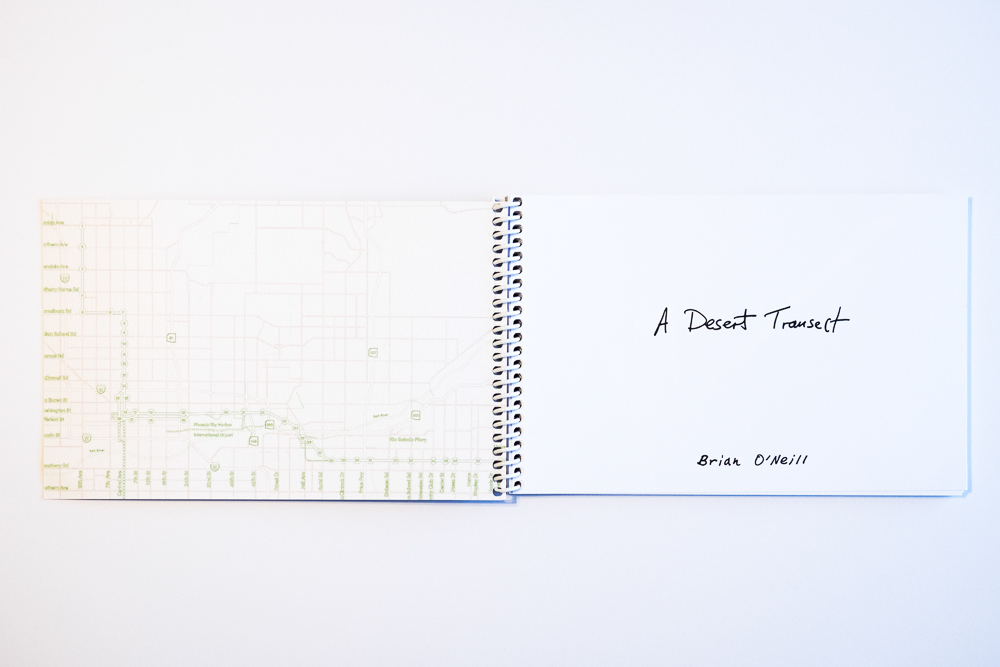
While using public transportation is very different depending on where you are in the world, it tends to be a banal experience that we often literally sleep through – if it’s safe enough to do so – or one we want to put behind us as soon as we arrive at our destination when the service is inefficient. Yet, public transportation is also a microcosm that evidences issues related to precarity, crime, climate change, and urban planning. A Desert Transect (Immaterial Books, 2025) is a playful take on issues related to the Light Rail in desert city of Phoenix, Arizona. Its author, Brian O’Neill, transforms the act of using this particular mode of transportation into an exercise of attentive looking, academic scholarship, and creative writing. His mix of pictures and astute observations results in one of those slim books that leave you pondering everyday life long after closing its spiral-bound cover (and yet another example confirming that a photobook doesn’t have to be expensively printed to be effective).
***
Arturo Soto: Let’s start with a basic question: how would you describe the Phoenix Light Rail for those of us who haven’t ridden it, and why did you become interested in it?
Brian O’Neill: The Light Rail is an above ground public transit system extending through Phoenix, Arizona. Many lines are downtown and therefore are not really useful as commuter infrastructure. Although, there has been a movement to change this as lines have extended to the satellite cities and suburbs. Initially, what interested me was simply that it existed at all. I think that to the extent that Phoenix exists in the popular imagination, it is thought of as the pre-eminent expression of “American” mobility: an interminable circuit of highways encompassing a horizontal grid of tarmac and concrete.
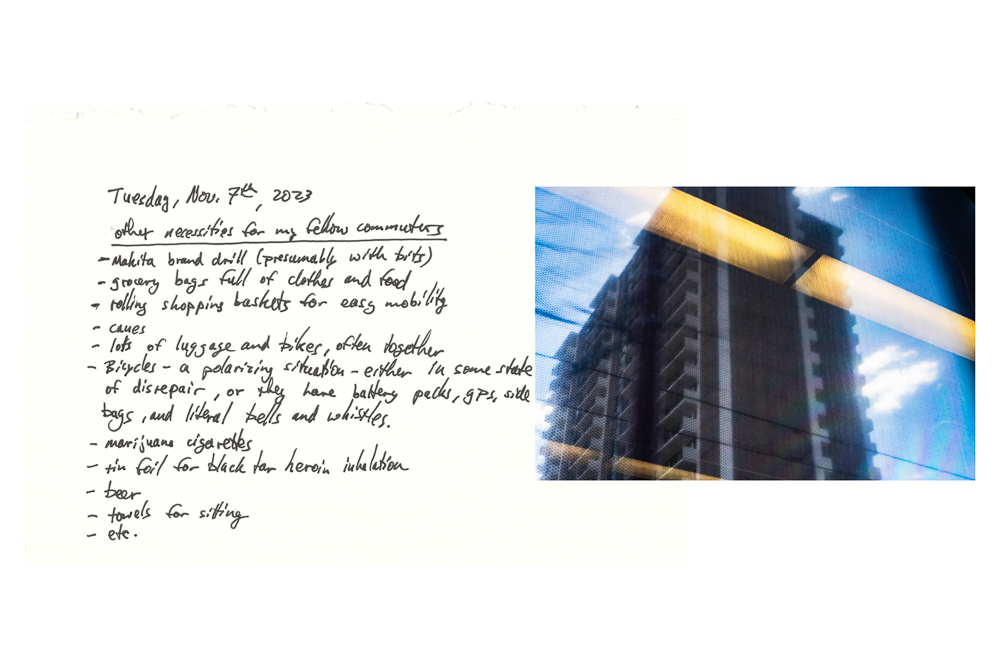
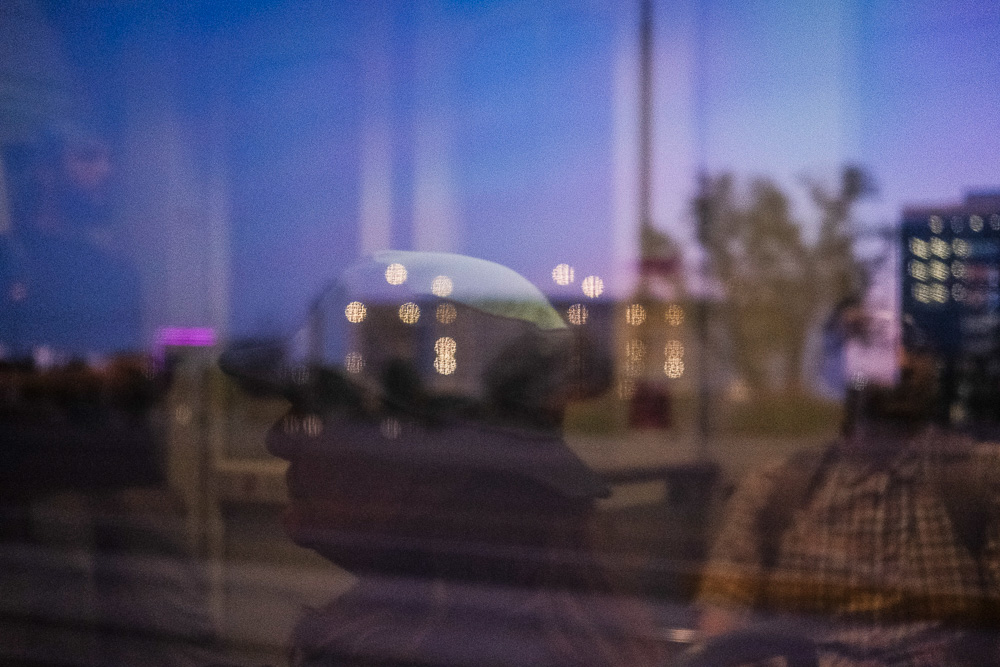
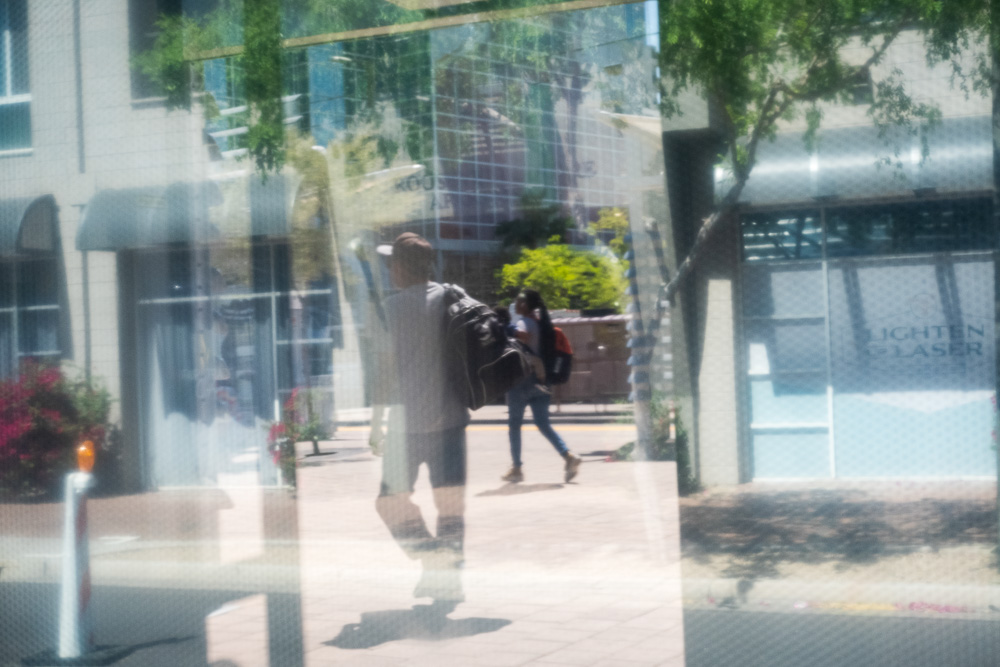
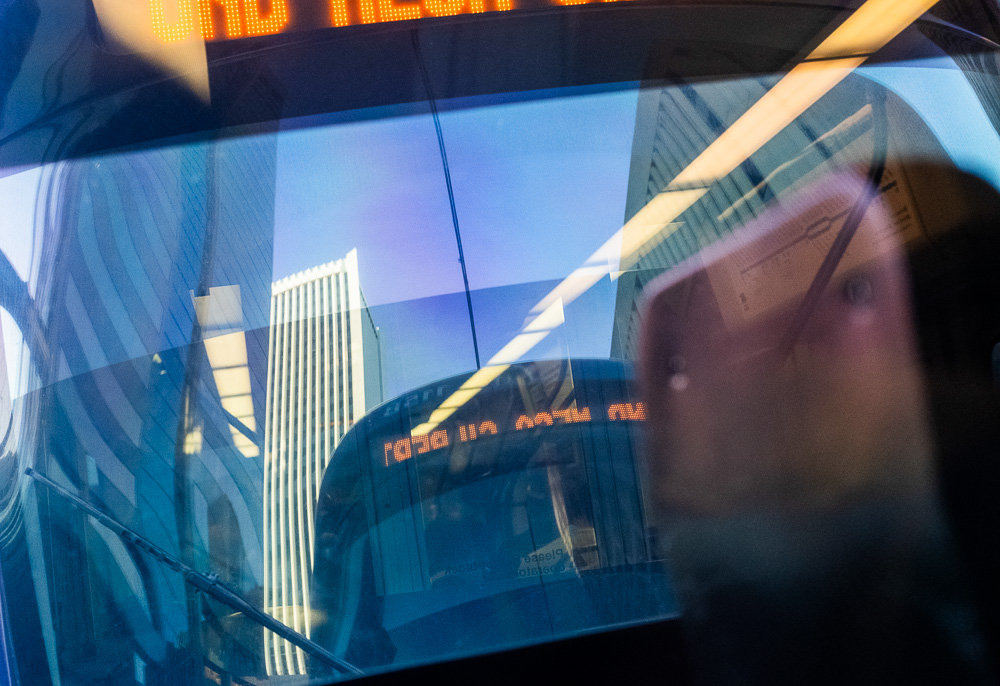
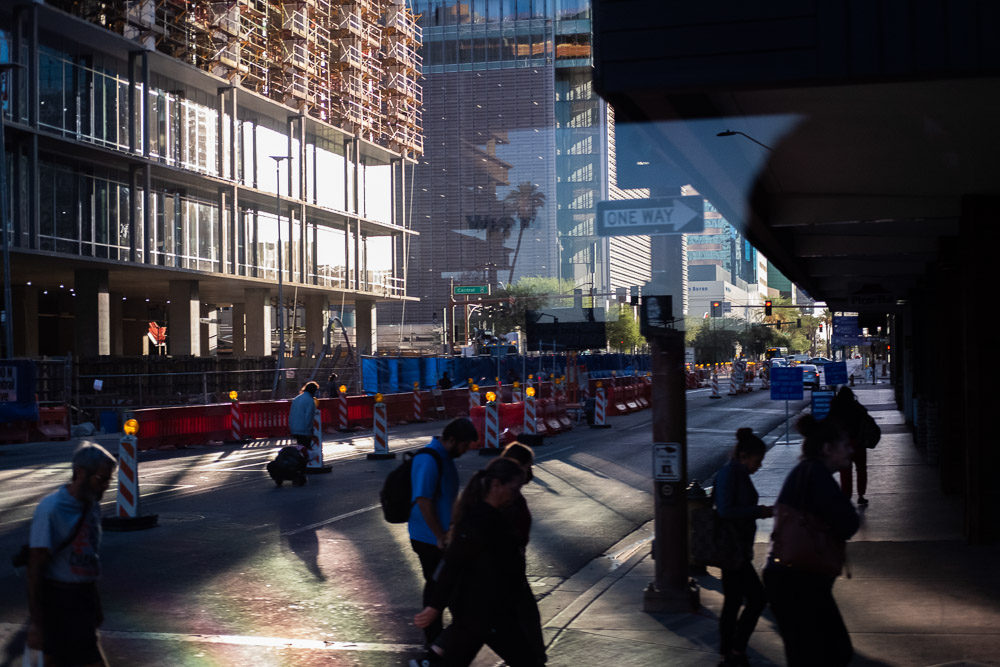
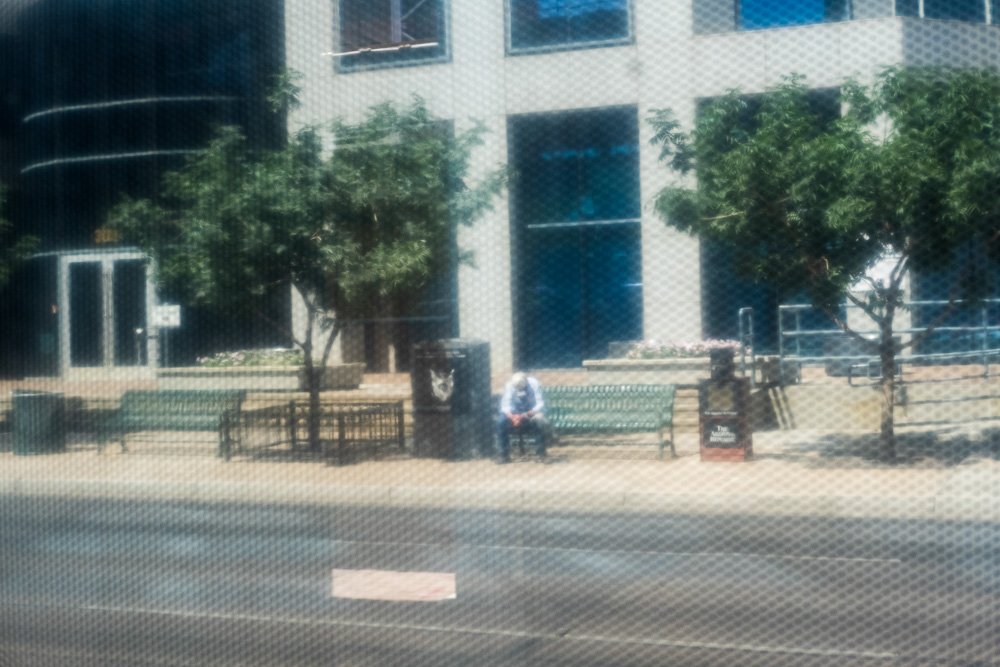
Through my direct experience, these impressions were broken down. I am always fascinated by these things, because I did not grow up in a city environment, and here I was in one of the largest in the country. The visual dimension of my rides became immediately apparent. As most people can probably relate, one of the joys of train rides is looking out the window. But, as I was looking, my eyes had difficulty focusing on the city passing by, because there were often advertisements on the glass, which itself showed color shifts. The advertisements also often had small holes poked in them as part of the manufacturing process to allow light to enter the rail cars. I then tried to find a way to work with this initial visual irritation, shooting into these obstructions. As I did this, I reflected on how photographers and scholars have described transit systems, and I had a clear idea of what these types of works were – gritty scenes of urban decay, situations bordering on supposed “disorder.” But, in my case, I was above ground and the sun was ever-present. This seemed different, and the line itself covered a lot of the “core” of Phoenix. So, the obstructions became a little metaphor of my experience of learning about the city in a quotidian way.
AS: A Desert Transect feels like an extension of your work as a sociologist. What role does research play in your photography? Have you found overlapping methodologies or strategies?
BO: Making images is the initial way that a place and its people become a part of my understanding. In that way, I am always working to break down any abstractions of a place and the way people are represented there. This connects to the way I do research too. As I begin to experience a place, I begin to find literature that talks about the location. This kind of research and visuals are always connected for me. Furthermore, there is a tradition in sociology and anthropology of visual work. And, the further one goes back into the archives, the more crossover you see with documentary photography. Broadly, the idea of a survey is common to these disciplines. But, how to provide such an account?
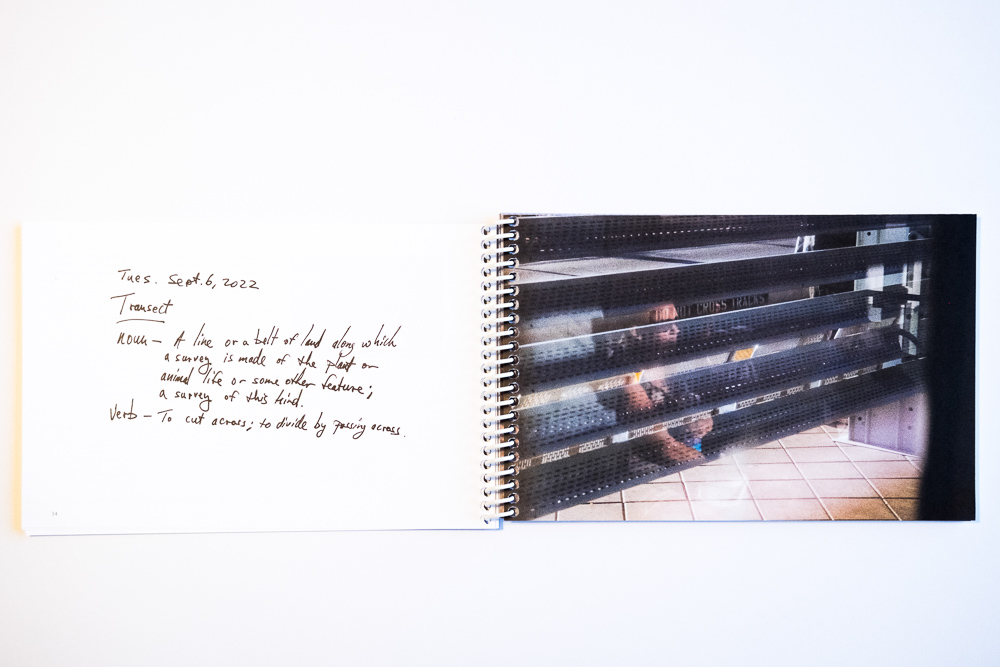
A methodology emerged as I began thinking about transects. Even if not often overtly stated, this idea can be seen in documentary photography and cultural geography. A transect is a classical scientific sampling technique – a line in the landscape to then identify an area’s characteristics. What interested me was how contemporary authors are thinking of this as a way to expose the tensions of the places they are working in, as much as that of their disciplines. My solution for the project was to then adapt the transect as a method. Once I had this in mind for this project, it became clearer to me how I could experience the world, to make pictures, and to write, while constantly holding onto the problem of how we describe the world.
This may not necessarily be different from the way some documentary photographers in the arts operate. To be sure, I have come across lots of “line” related projects. However, I also see lots of documentary work that has no apparent spatial or social principle in the way it was executed. But as this was a project about space in many ways, it made sense to do this. I’m not saying there is a right answer here, but I like to have some minimal rules in place to help me delimit the horizon of inquiry. In this way, I was and continue to actually “fight” with the concept of survey. It is unreasonable to think one can totally describe a place or a culture (a leap that is encouraged by facile readings of the work of some visual ethnographers or documentary artists). By setting the terms of your engagement and concentrating on some aspect of a place, we still can come to know it in a general sense.
A transect is a classical scientific sampling technique – a line in the landscape to then identify an area’s characteristics.
AS: Your book has elements of academic publications as well as of artist’s books, which creates an uncommon tension. How did its design come about? Why did you decide to open with an academic essay rather than with the work, which is a mixture of texts and pictures?
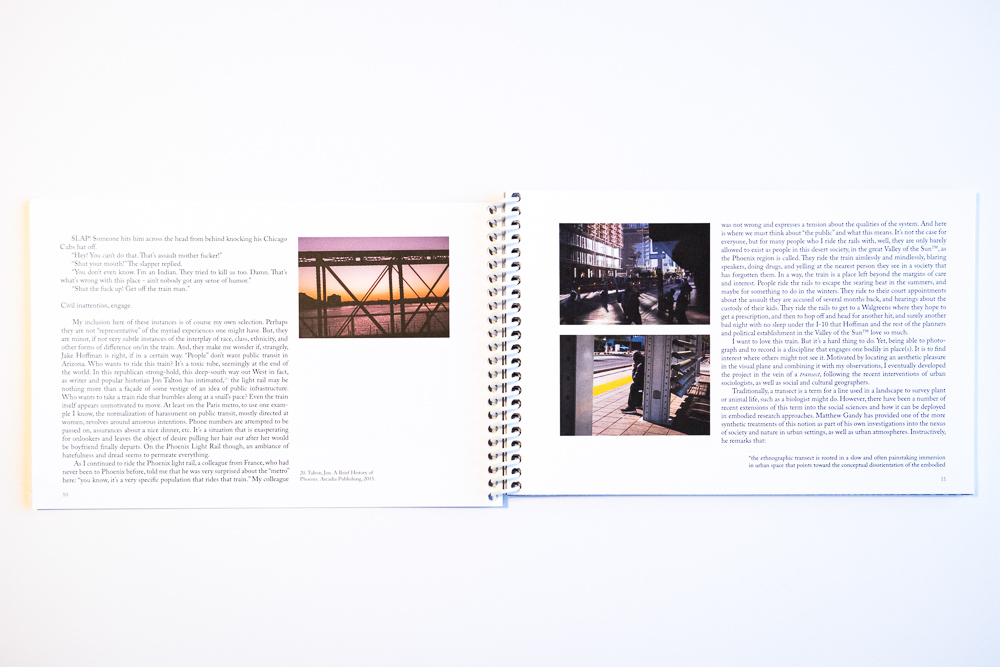
BO: It is a project full of tensions! If that is preserved, then maybe something of the city is preserved. My designer for this project, Alex Wilk, and I, had many discussions about this. We decided a way to preserve both the riding experience, and the more contemplative aspects was through this dual presentation. As a photobook critic myself, I’m aware that photographers like to refrain from explanation. And maybe social scientists go too far in theirs. But, without precise discussions, a danger is that too much interpretive latitude is given over to the “reader.” I hope that the combinations of both the formal text, and then the more impressionistic texts accompanying the images allow the reader to grasp the ways in which the Light Rail is a place of social activities and contemplation, about oneself, but also broader patterns of politics and the economy. The goal was to deepen an engagement with the city and try to open further this method of working to other people.
AS: You refer to the project as an “ethnographic exercise.” Can you expand on this definition?
BO: Ethnography, at its core, is about the textual description of some aspect of social life. I wanted to explore what this could mean, as in practice, it often means a rather monolithic mode of written text. How many ways could I describe a place that had so much velocity to it, and still retain a level of coherence? Cities are very much always proliferating and spilling out of themselves – there are advertisements, and people working, people doing all sorts of things, there is music, moving images, infrastructure, and smells. I was wondering if I could, in some sense, strike back with a similarly multisensory counterpoint by combining different mediums of expression.
Ethnography, at its core, is about the textual description of some aspect of social life. I wanted to explode what this could mean.
AS: Sociological projects usually prove or disprove something and, therefore, have a close relationship with truth and objectivity, whereas art’s relationship to those concepts is fluid. However, there is an historical expectation for documentary photography to establish a clear position in its description of the real. Did these conventions influence how the project developed?
BO: This question of the real is why I often return to the nexus of sociology and documentary photography. We could say I have a “realist approach,” that is, an interest in how people and their perceptions define a place, while simultaneously realizing the need to grasp how the situation is influenced by forces beyond the individual. In other words, there may not always be definite answers to problems, but there are real problems. In this regard my idea is that some combination of documentary photography and sociology can provide a kind of clarity on social problems that photojournalism sometimes fails to provide.
What if we traded aesthetic abstraction for theoretical abstraction and empirical abstraction for aesthetic expression? How could this allow us to deal with political themes? I think if these questions are difficult to answer, then they may be worth pursuing. What was exciting about this project was that, firstly, I was in the real world, living my life. But I was also in a place that I felt was surreal: Phoenix is expansive, it’s unbearably hot, and in many ways, it seems unfit for life. Yet, it is a huge city that’s growing. On top of that, despite the discourse around individualism, which is represented by the car, I find that “public” offers a view of the city, through its glass and windows, that shows life. When photographed in a certain way, it offered an expressionistic quality. What was real and true about this experience was that it always presented me with freshly bizarre aspects. To put it even another way, you can imagine a strict visual sociology of the tram system: one photographs the interior of the same rail car every day for a month. Then one crafts statistics about incidents of violence, numbers of interactions, and racial, class, and gender diversity (or lack thereof), etc. This is one tradition of visual sociology. It is straightforward. I wouldn’t have to answer your question had I done this! But I tend towards a more interpretive school of thought. I was interested in the experience of a body moving through the city on the train and I tried to listen to where this more intimate experience would take me.
So, the Light Rail, as a subject, was a kind of “laboratory” for me in this regard. It is, in a somewhat contradictory way, an ultimate place of individuality. As I write in the book, the way the technology itself exists is such that it allows us to socially adapt ourselves to ignore each other. Yet, this (un)comfortable dimension is precisely the thing that might then jar us into thinking about society and thus the truth of the situation. To think about society is to be aspirational. It is to think about how unequal our present is, why that is, and what could change. This is part of the message of A Desert Transect. It is an example of how bodily engagement with the city fosters social realizations. And so, if we don’t have a clear lexicon of how to talk about issues at the nexus of science/art, visual sociology/documentary photography, it may be because too few people probe these tensions, or that at least we need to continue to explore them.
To think about society is to be aspirational. It is to think about how unequal our present is, why that is, and what could change. This is part of the message of A Desert Transect.
AS: The project is composed of the book, but also a video and an album by Wyoming Toad. What do you think these components contribute to the project, and what is, for you, the ideal way to engage with them?
BO: On the one hand, I made all these components, because it was simply fun, while exhausting, and I wanted to experiment with all the ways to present a body of work about a single subject. It’s important to try to enjoy what you are doing. For the reader, this gives verisimilitude. Also, it is the case that in daily life, we do not deal with all the sensual dimensions simultaneously. We filter things out. My idea was that you could engage two at once. Sound and visual. You can even compare the film with the experience of combining the book and the album. If I was to suggest an approach to viewing, I would say listen to the album as you peruse the book, then watch the video. In a way, it’s back to the basic concept of mobility in that I hope the book inspires an active reading.
AS: In your text in the book, you assert that visual ethnography should have a different aesthetic from fine art photography, but the history of modern and contemporary art shows that artists borrow, quote, or copy the aesthetics of other disciplines for their own purpose. Is it relevant that audiences know that the project is operating within the aesthetic boundaries of another discipline?
BO: I see this more and more with rigorously researched art projects, often, it seems, on geopolitical themes. A Desert transect is obviously open to readers’ interpretations, whether they know the disciplinary concerns or not. That is part of why I made so many ways for a possible audience to encounter the work – through sound, visuals, and text. Directly to your question though, I am asserting this precisely because I feel visual ethnography has sometimes done too good a job of defining itself. I’m thinking here of some of the writing of Howard Becker and Frank Cancian, reacting to, among others, John Collier Jr. They were against methodological purism, and for a certain openness in terms of ‘ways of telling’ about cultures and society. Fundamentally, there are some foundational connections between fine art documentary work and ethnography. But, at the level of practice, this deserves more exploration, which is part of why I wrote it that way! Yet, the disciplines are distinct, at least in their emphases and tendencies to theory and modes of expression. Furthermore, while many documentary photographers make books, the tradition of visual ethnographers doing this is comparatively little explored or exposed
AS: What did you want your handwritten texts to accomplish?
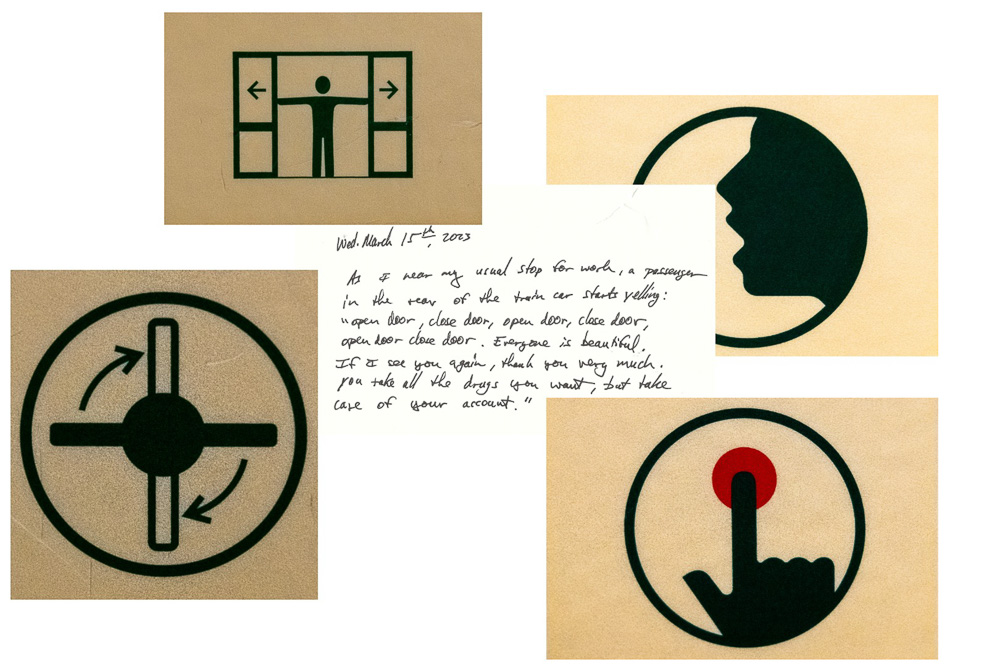
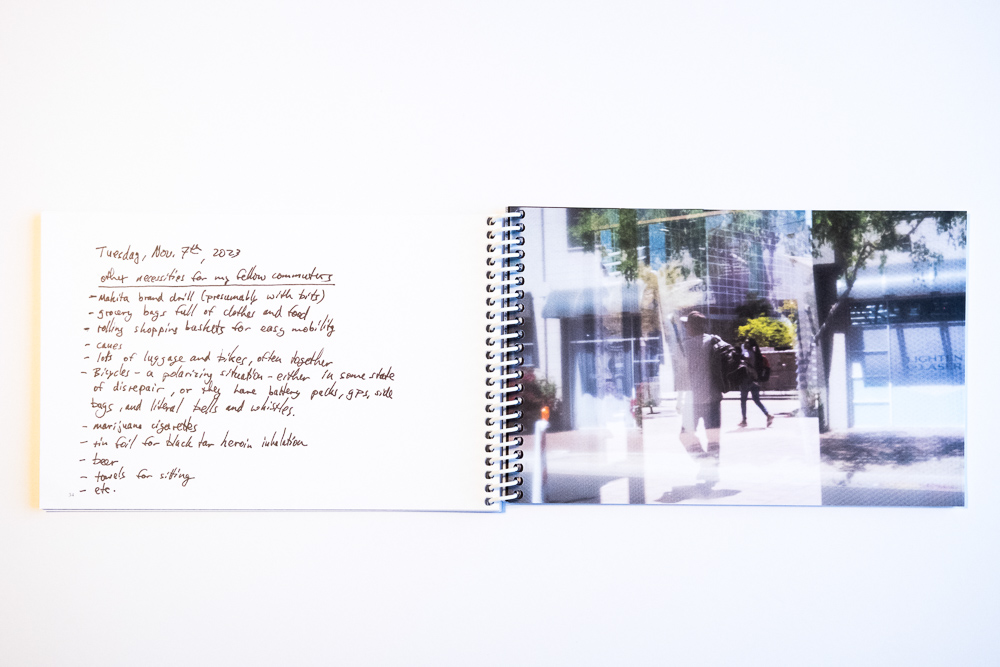
BO: An element I always love in books is immersion. The handwriting was a design decision we went back and forth on, ultimately deciding to keep the texts as I wrote them during or shortly after my train rides. Hopefully it brings the reader a little closer to the experience of making the work rather than just seeing the book-object as an end in itself. All in all, I hope it can inspire someone else to be attentive to what is happening around them and what they are doing in situations they may take for granted.
AS: This project is part of a longer examination of mobility in the Phoenix area. What are your plans?
BO: Most recently, the mobility issue led me to work on extreme heat. This is a theme that emerges in A Desert Transect but is not foregrounded. How people get around the city is important and this is made more or less possible by how the built environment interacts with transportation and other infrastructure. I have been experimenting with ways to do a project about the car too and I hope that will be a next step in this larger project.
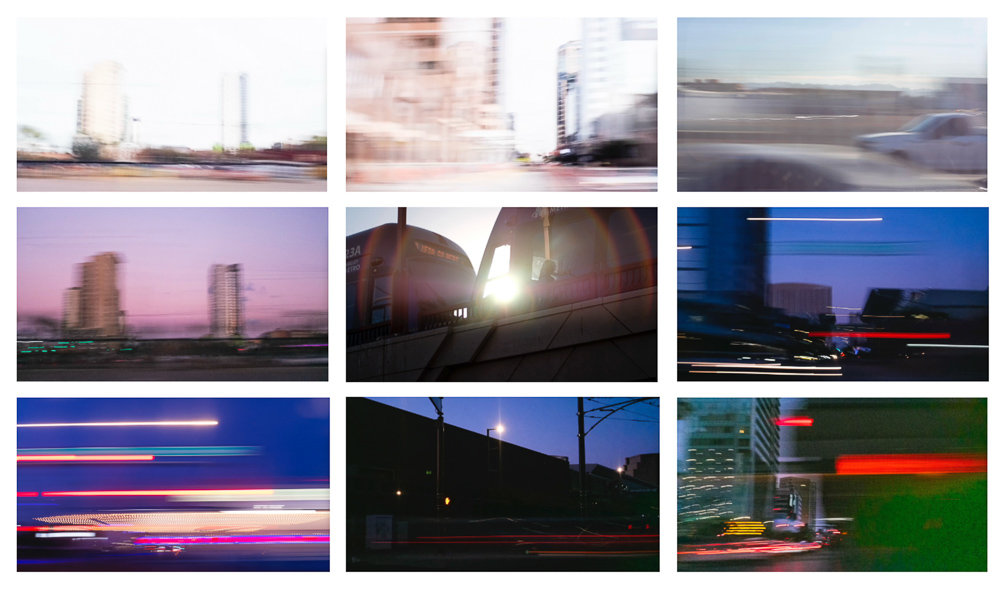
AS: Many of the pictures included are expressionistic, making them more about color and form rather than the socioeconomic experience of riding the Light Rail, and yet, they also reflect the physical effect of the train moving through space. How did you settle on the aesthetic of the photographs?
BO: Precisely, this is the beauty of visual ethnography and/or documentary work – one encounters these combinations of themes and elements that one wouldn’t have imagined! My initial reaction for making a project was to interview and photograph riders. For one thing, this would have been methodologically clean, but that was also something I had seen before from journalists, and we can all think of the classic photographers who have done something in this vein. The more time I spent riding, the more I realized that if there was something I can offer in this tradition of train projects, it could be this, somewhat unique visual experience that was being offered to you, if you looked long and hard enough. While many are expressionistic, it is also true that this is the literal visual experience of the train – the pictures are all “straight,” single frames.
Brian O’Niell
Immaterial Books